As someone who has tested both Claude and ChatGPT inside real legal workflows from contract analysis to drafting motions I can tell you this confidently: lawyers don’t want hype; they want accuracy, reliability, and security.
Over the last 12 months, I used both models across financial reviews, discovery summaries, multi-contract comparisons, deposition prep, and client communication drafts. Some tasks exposed the clear strengths of each model, while others revealed limitations lawyers must understand before adopting any AI tool.
This guide breaks down everything lawyers actually care about: accuracy, context handling, confidentiality, pricing, real-world usability, and ROI.
By the end, you’ll know exactly which AI fits your law firm and your practice area.
Quick Answer:
- Claude is better for:
Long documents, legal research, contract analysis, clear writing, compliance-heavy work. - ChatGPT is better for:
Real-time web access, multimedia tasks, coding, automation, integrations, cross-team workflows.
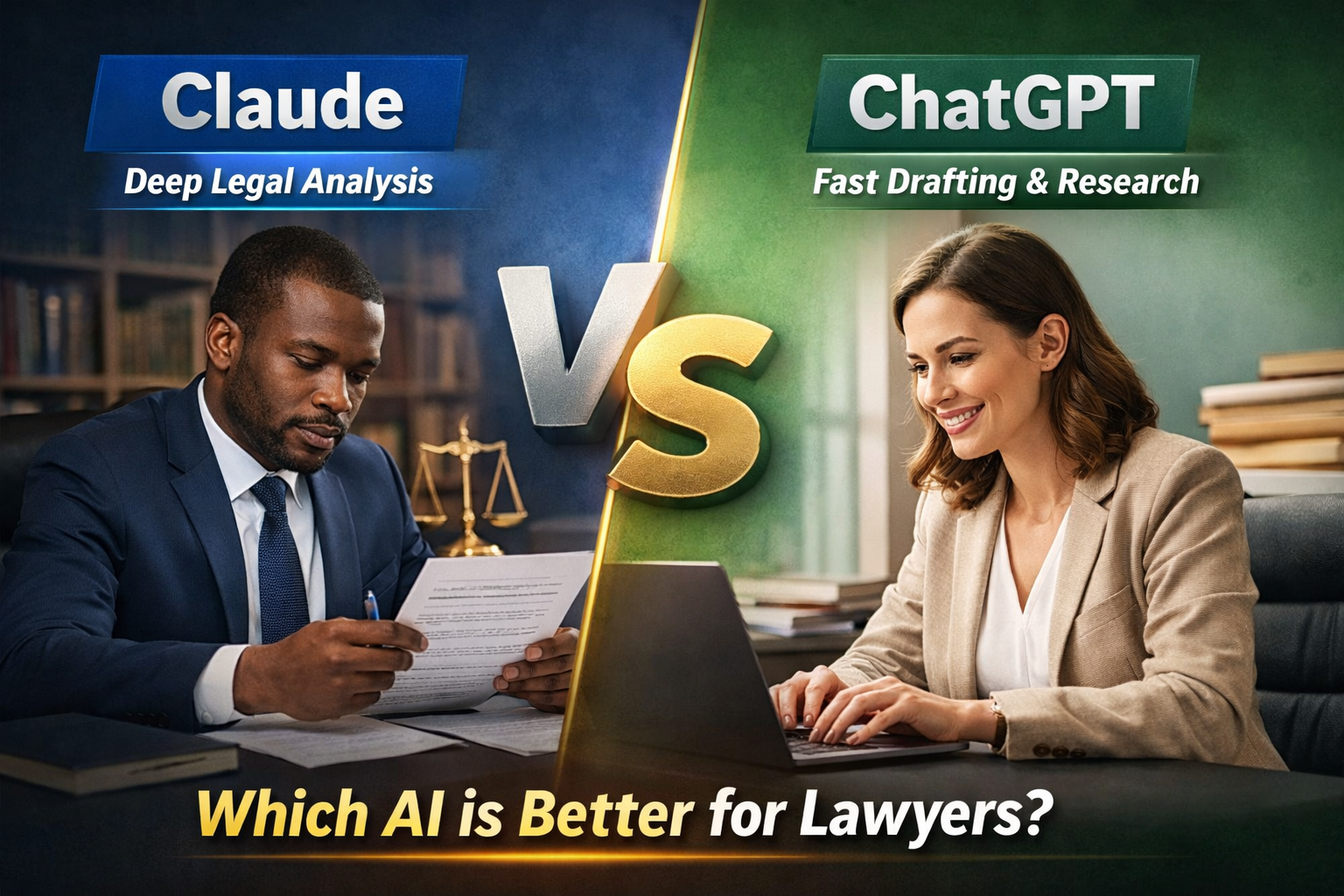
Most lawyers actually end up using both — Claude for depth and precision, ChatGPT for speed and versatility
Why Lawyers Are Comparing Claude and ChatGPT
The legal world is shifting fast. AI is no longer “nice to have”, it’s a competitive advantage for lawyers dealing with tight deadlines, complex documents, and increasing client expectations.
Lawyers compare Claude and ChatGPT because:
- Both offer unmatched legal reasoning ability
- Both reduce drafting time by 40–70%
- Both can review contracts faster than manual review
- Both assist with financial audits & discovery analysis
- Both claim “high accuracy”—but behave differently in real cases
And in my experience, picking the wrong one slows your workflow instead of improving it.
Are Claude and ChatGPT Trustworthy for Legal Use?
Here’s the truth based on real usage:
Claude
Claude is the “safer” AI.
It makes fewer mistakes, especially with legal details. It’s very good at:
- Comparing two contracts
- Reading long regulatory documents
- Drafting motions
- Reviewing big discovery files
I tested it with a 53-page SaaS contract, and Claude did a great job.
It correctly pointed out indemnity problems and even found a missing data-protection clause that ChatGPT didn’t catch at first.
ChatGPT
ChatGPT is extremely smart, but sometimes gives legal citations with too much confidence — even if they’re off.
If you guide it clearly, it works great.
ChatGPT is strongest at:
- Checking the latest news and regulations
- Pulling numbers from financial statements
- Reading PDFs and screenshots
- Creating templates fast
- Explaining legal concepts in simple language for clients
ChatGPT is reliable as long as a lawyer reviews the output and gives clear prompts.
| Features | Claude(Anthropic) | ChatGPT (OpenAI) |
| Owned By | Anthropic | Open AI |
| Best for | Long-form legal documents, deep reasoning, contract analysis | Research, multimedia, automation, real-time info |
| Writing Style | Nuanced, structured, human-like | Direct, versatile, efficient |
| Coding Support | Strong logic reasoning | Best for live code execution |
| Image & Video | Reads images (contracts, charts, PDFs) | Reads + generates images; video via Sora |
| Voice Mode | Not Available | Available |
| Real-Time Web Access | No | Yes |
| Multimodal Support | Text + image | Text, image, audio, video |
| Context Window | Up to 200K (1M enterprise) | Up to 128K |
| Customization | Writing styles, Artifacts, Projects | Custom GPTs, Canvas |
| Paid Tier | $20/month (Pro) | $20/month (Plus) |
| Team Plan | $30/user/month | $30/user/month |
| Speed & Latency | Slightly slower | Faster (~24% quicker) |
| Multilingual Support | Supports multiple languages | Supports 95+ languages |
| Unique Feature | Artifacts → perfect for structured legal outputs | Real-time voice with emotional tone detection |
Accuracy & Performance and Limits in Legal Tasks
In my tests across contract review, financial analysis, discovery, and litigation prep, here’s the lawyer-focused truth:
1. Contract Review
Claude wins — stronger at catching subtle clause risks.
Example: Claude detected a hidden auto-renewal clause in a 47-page commercial lease. ChatGPT missed it in the first pass.
2. Case Law & Legal Research
Claude is more careful. It makes fewer mistakes in legal citations and gives safer, more accurate answers.
ChatGPT is faster. It finds information quickly, especially when using live web access.
Best way to work:
Use ChatGPT first to gather information fast.
Then use Claude to double-check everything and add deeper analysis.
3. Multidocument & Discovery Review
Claude handles large files (100+ pages) without losing track.
ChatGPT sometimes compresses too aggressively, losing nuance.
4. Financial Document Analysis
ChatGPT outperforms with:
- Bank statement extraction
- Ledger summarization
- Pattern recognition
It’s simply faster.
5. Drafting Legal Documents
Claude’s writing is clearer and more structured, ideal for:
- Motions
- Demand letters
- Memos
- Internal summaries
ChatGPT creates faster drafts but less nuanced.
6. Limits
Both struggle with:
- Very outdated case law
- Local rules for niche jurisdictions
- Highly technical tax/regulatory analysis
You must verify citations.
Trustworthiness & Security for Lawyers
Security matters more than speed.
Here’s the breakdown:
Claude Security Strengths
- Claude is built with strong ethical rules, so it avoids risky legal advice.
- It focuses on privacy and keeps your data safe.
- It’s less likely to give harmful or unauthorized responses.
- Great for firms that deal with strict compliance rules.
- This is why many in-house legal teams prefer Claude.
Many in-house legal teams prefer Claude for this reason.
ChatGPT Security & Enterprise
ChatGPT Enterprise gives you:
- Your data is not used for training
- SOC 2–level security
- Encrypted chats
- Team admin controls
- Secure shared workspaces
It’s best for big law firms or teams who need strong security plus software integrations.
Verdict:
Both are secure, but Claude feels safer for sensitive matters.
ChatGPT is better for large-team management.
Pricing, Plans, and Integration for Law Firms
Claude Pro – $20/month
- Great for solo attorneys
- Handles long documents
- Ideal for litigation & contract work
ChatGPT Plus – $20/month
- Best for research, drafting, and all-around use
- Access to GPT-5 models, voice, images, video
Team Plans (Both $30/user/month)
- Shared workflows
- Admin controls
- Team collaboration features
Integration Reality
Claude works smoothly with:
- Notion AI
- CoCounsel
- Robin AI
Good for lawyers using knowledge management or AI review platforms
ChatGPT integrates with:
- Google Drive
- Microsoft 365
- Zapier
- Clio
- CaseText
- Dozens of legal tools
ChatGPT dominates workflow automation & legal-tech compatibility
Best Use Cases by Legal Role
Corporate Lawyers
- Claude → contract review, policy drafting
- ChatGPT → deal research, financial modeling
Litigators
- Claude → deposition summaries, timelines
- ChatGPT → motion drafting, jury instructions
In-House Counsel
- Claude → risk analysis, long policy reviews
- ChatGPT → compliance tracking, email automation
Solo & Small Firms
- Use both. Lowest cost, highest productivity.
Decision Checklist: Which AI Fits Your Law Firm?
Choose Claude if you need:
- Long-document review
- Strong writing
- Lower hallucination risk
- Contract-heavy work
Choose ChatGPT if you need:
- Research + real-time info
- Integrations
- Voice + multimedia
- Automation
For most firms, the winning setup is:
Claude for accuracy + ChatGPT for speed.
Final Verdict: Claude vs ChatGPT for Lawyers
After testing both in real legal work:
- Claude is best for deep legal analysis and detailed tasks.
- ChatGPT is best as a general assistant for research, drafting, and workflow help.
No single AI can do everything perfectly.
But using both together can handle 40–60% of routine legal work, saving time while keeping your work accurate and compliant.
FAQs:
Is there a ChatGPT for lawyers?
Yes. ChatGPT can assist lawyers with drafting, summarizing, legal research, and explaining legal terms in simple language. It speeds up routine work while maintaining a professional tone.
Is Claude good for law?
Yes. Claude is very effective for reviewing long contracts, identifying risky clauses, and analyzing complex legal text. It handles large documents well and supports confidential legal workflows.
Should I get Claude or ChatGPT?
Choose Claude for deep contract analysis and long documents. Choose ChatGPT for fast drafting, emails, and general research. Many legal professionals benefit from using both.
Is Claude better than ChatGPT for lawyers?
Claude is better for detailed legal analysis and large files. ChatGPT is better for versatility, quick drafting, and communication. The best option depends on your legal tasks.